
Knowing how to talk to kids about AI matters more than knowing every technical term. Children need calm, honest conversations about what AI can do, where it fails and when to ask an adult for help. Use the age-based explanations and prompts below to start a conversation that grows with your child.
How to Talk to Kids About AI by Age
Your child is already using AI — whether they know it or not. From YouTube recommendations to voice assistants to AI-generated content in their social feeds, artificial intelligence is woven into their daily life. This guide helps you start meaningful conversations about AI that build understanding without creating fear.
Why Parents Need to Talk About AI Now
AI is no longer science fiction. Children are interacting with AI tools in school, at home and through entertainment. Without guidance, they may develop misconceptions — believing AI is magical, infallible or dangerous. The goal is to help them become informed, thoughtful users of AI technology.
Age-Appropriate AI Conversations
Ages 4 to 7: “Smart Helpers”
At this age, focus on the idea that some machines can learn from examples — just like children do. Point out everyday AI: “Alexa can understand your voice because people taught it lots of words.” Keep it concrete and relatable. Avoid technical jargon.
Ages 8 to 11: “Pattern Finders”
Children at this age can understand that AI works by finding patterns in data. Show them examples: how Netflix suggests shows based on what they have watched, how spam filters learn which emails are junk. Introduce the idea that AI can make mistakes because it only knows what it has been trained on.
Ages 12 and Up: “Powerful but Limited”
Teenagers can engage with deeper concepts: bias in AI training data, privacy implications, deepfakes and misinformation, the difference between narrow AI and general intelligence. Encourage critical thinking: “Just because an AI said it does not mean it is true.”
5 Questions Kids Ask About AI
- “Is AI alive?” — No. AI is software running on computers. It does not have feelings, consciousness or desires. It processes information and produces outputs based on its training.
- “Will robots take over?” — Current AI is very narrow — it can do specific tasks well but cannot think, plan or want things the way humans do. The robots-taking-over scenario is science fiction, not reality.
- “Can AI do my homework?” — AI tools can help with research and learning, but submitting AI-generated work as your own is dishonest. Using AI to understand a concept is learning. Using AI to avoid learning is cheating.
- “Does AI spy on me?” — AI systems do collect data to work properly. This is why privacy settings matter. Teach children what data they share and how to control it.
- “Will AI take my future job?” — AI will change many jobs but also create new ones. The best preparation is learning to work alongside AI, think critically and solve problems creatively — skills that are hard to automate.
Building AI Literacy at Home
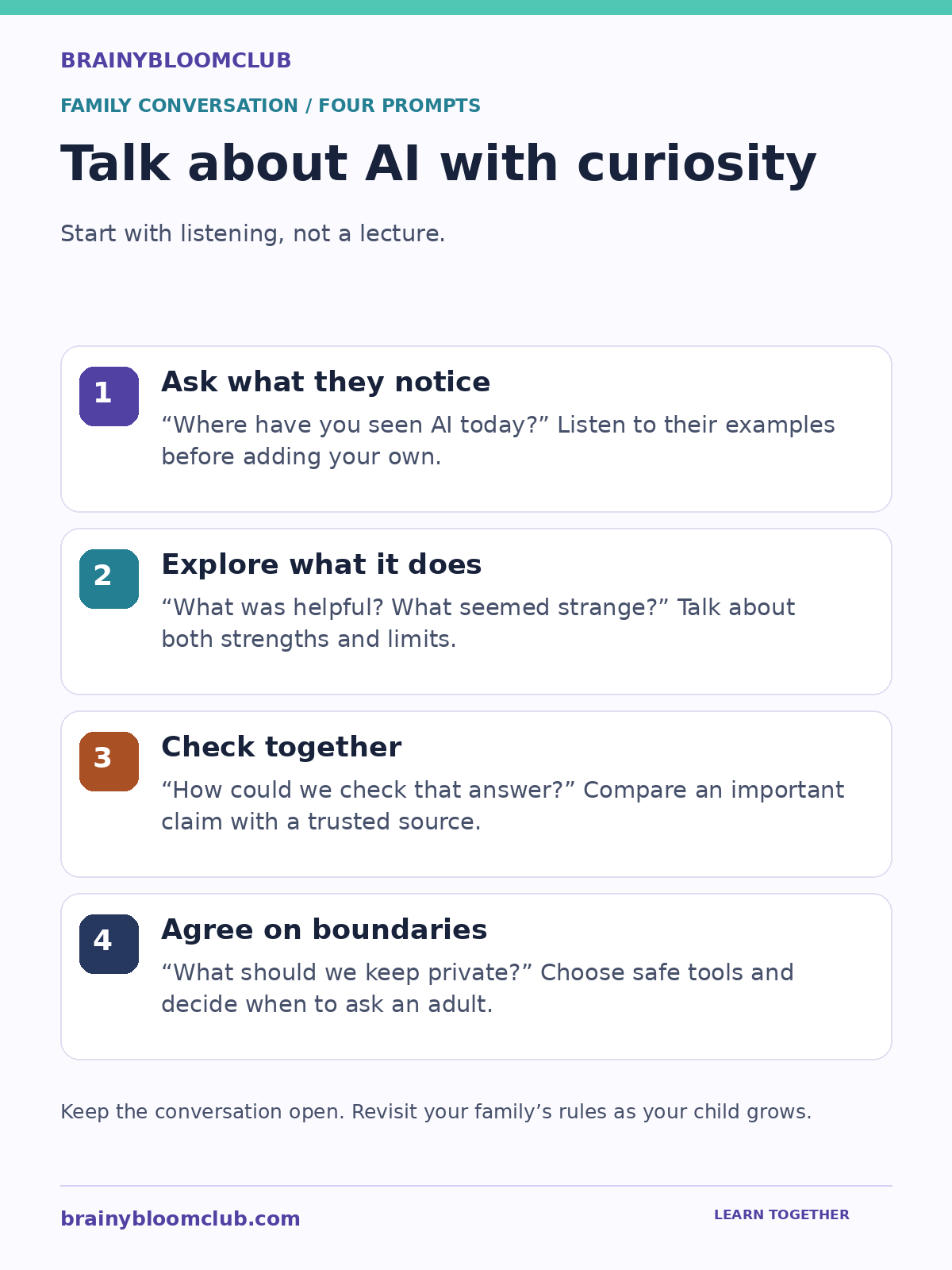
Graphic summary: Ask where your child notices AI, discuss what seems helpful or strange, check important answers together and agree on what to keep private.
- Experiment together. Try AI tools as a family — image generators, chatbots, music creators. Discuss what the AI does well and where it fails.
- Play “spot the AI.” Challenge children to identify AI in their daily life: autocorrect, face filters, game opponents, personalised ads.
- Discuss AI in the news. When AI stories appear in the media, talk about them. Separate hype from reality together.
- Encourage creation over consumption. Instead of just using AI, encourage children to learn how it works — through coding, robotics or AI experiment platforms designed for kids.
Frequently Asked Questions
Should I let my child use ChatGPT?
Most AI chatbots have age restrictions (typically 13+). For younger children, supervised use can be educational. For teenagers, focus on teaching them to verify AI outputs, understand limitations and use it as a tool rather than an authority.
How do I keep up when AI changes so fast?
You do not need to be an expert. Focus on principles that stay constant: critical thinking, privacy awareness, ethical use. The specific tools will change, but the ability to evaluate them thoughtfully will always matter.
Explore more parenting resources on our Parents hub and learn about AI basics on our AI hub.
Sources and Further Reading
BrainyBloomClub reviews child-facing technology guidance against current provider information and established child-safety resources. Last reviewed: August 2026.
Next step: Explore the Artificial Intelligence hub, Digital Safety hub or STEM Projects hub for related age-guided resources.