
Every parent knows coding matters. But ask which language your child should learn first and the answers multiply fast. Python. Scratch. JavaScript. Roblox. Everyone has an opinion.
This ranking cuts through the noise.
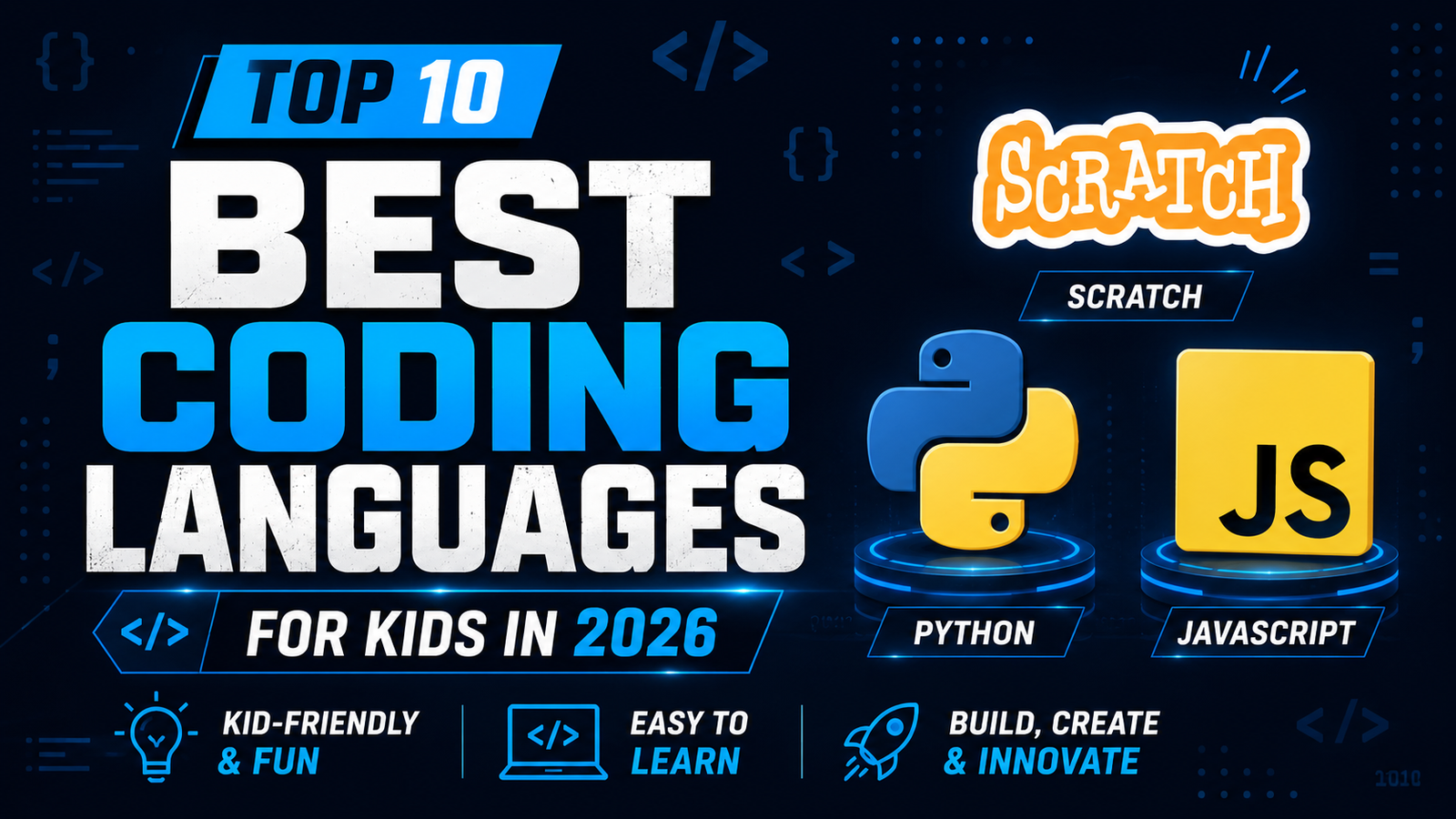
Using kid-friendliness scores, age suitability, and real job market demand data, we ranked the top 10 programming languages for children and teenagers in 2026.
The results will help you make a decision based on evidence, not trends.
10. Java — Kid-Friendliness: 6.5/10 | Age: 13+
Java is one of the most established programming languages in the world, powering Android apps and large enterprise systems.
It remains widely taught in schools and commands approximately 300,000 job postings globally.
For younger children, it is too verbose and structurally complex. But for teenagers serious about software engineering or Android development, Java builds disciplined coding habits that transfer across languages.
9. Swift — Kid-Friendliness: 7/10 | Age: 13+
Swift is Apple’s language for building iPhone and Mac applications. Apple’s interactive Swift Playgrounds app makes it one of the more accessible introductions to professional development for teenagers with Apple devices.
If your child dreams of building apps they can actually use on their own phone, Swift is the most direct path to that outcome.
8. C# — Kid-Friendliness: 7/10 | Age: 13+
C# is the language behind Unity — the game development engine used to build thousands of professional and indie games. For teenagers interested in game development beyond Roblox, C# opens the door to professional-grade creation.
With approximately 246,000 job postings and a TIOBE ranking that continues to rise, C# has strong long-term career relevance.
7. TypeScript — Kid-Friendliness: 7.5/10 | Age: 13+
TypeScript became the number one language on GitHub in August 2025, growing 66.6% year on year. It is increasingly described as the default language of modern web applications.
For older teenagers already comfortable with JavaScript, TypeScript is the natural and career-relevant next step. It is not a starting language — but it is a critical one.
6. Ruby — Kid-Friendliness: 8/10 | Age: 8+
Ruby is consistently underrated in conversations about kids and coding. Its syntax is clean, readable, and close to plain English — which makes it genuinely accessible to children as young as 8.
While its job market share is smaller than Python or JavaScript at approximately 60,000 postings, Ruby teaches coding logic in a way that transfers powerfully to every other language.
5. Blockly — Kid-Friendliness: 9.5/10 | Age: 10+
Blockly is Google’s visual block-based coding environment and one of the most important tools in children’s coding education. It sits precisely between Scratch and text-based languages — making it the ideal bridge for children ready to move beyond Scratch but not yet ready for Python or JavaScript.
Many professional coding education platforms, including BrainyBloomClub, use Blockly as a structured transition tool.
4. Lua — Kid-Friendliness: 9/10 | Age: 8+
If your child plays Roblox, they are already halfway to learning Lua. Roblox’s entire scripting system runs on Lua, making it the most naturally motivating entry point for game-obsessed children aged 8 and above.
The job market for Lua is smaller than Python or JavaScript, but for children who need a motivational hook to get started, Lua through Roblox is one of the most effective entry points in existence.
3. JavaScript — Kid-Friendliness: 8/10 | Age: 11+
JavaScript powers every interactive website on the internet. With over 651,000 job postings when combined with TypeScript, it represents the single largest employment category for developers globally.
For children aged 11 and above, JavaScript produces immediate visible results — buttons that click, animations that move, pages that respond. That instant feedback loop is one of the most powerful motivators in coding education.
2. Python — Kid-Friendliness: 9/10 | Age: 9+
Python is the language of the moment and the language of the future simultaneously. Named TIOBE Language of the Year in 2024, ranked number one on GitHub, and described by industry analysts as the control plane for AI and automation in 2026.
Approximately 408,000 job postings demand Python skills. It is the primary language for artificial intelligence, machine learning, data science, and automation — the four fastest growing technology sectors of the next decade.
For children aged 9 and above, Python’s readable syntax makes it genuinely learnable. For parents thinking about their child’s future, Python is not optional. It is foundational.
1. Scratch — Kid-Friendliness: 10/10 | Age: 5+
Scratch is the unanimous starting point. Developed by MIT, it is the gold standard for introducing coding concepts to absolute beginners from age 5 upward. No typing. No syntax errors. No frustration.
Scratch does not produce professional developers directly. What it produces is children who understand sequencing, logic, loops, and conditionals — the foundational concepts that every other language on this list is built on.
Every child should start here. The question is not whether — it is when.
Where to Start
The answer depends entirely on your child’s age and interest:
| Age | Start Here |
|---|---|
| 5–8 | Scratch |
| 8–10 | Scratch then Lua or Ruby |
| 10–12 | Blockly then Python |
| 13+ | Python then JavaScript |
The goal is not to pick the perfect language. The goal is to start. Every language on this list teaches logic, problem-solving, and computational thinking — skills that transfer across every career path your child might choose.
Which language is your child learning right now? Tell us in the comments.
Data sources: TIOBE Index 2024–2025, Stack Overflow Developer Survey, GitHub Language Rankings August 2025, Trusity, blog.herlein, JetLearn.